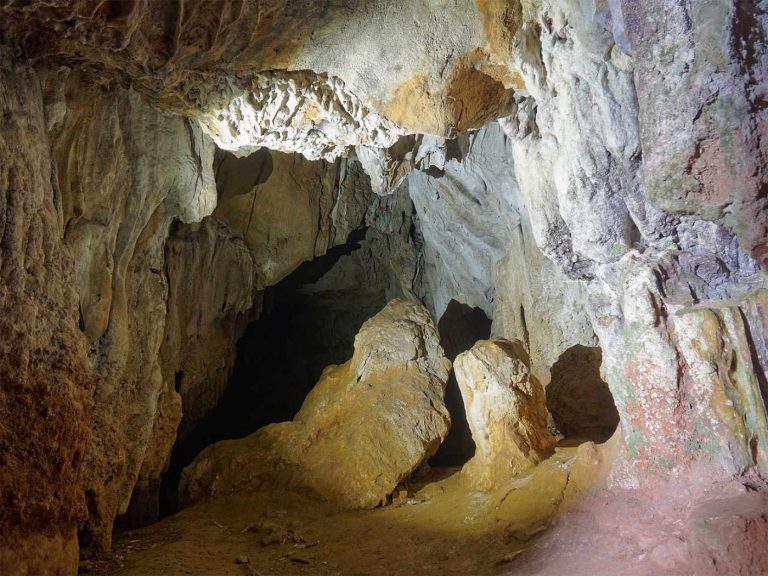
The Trapeza cave (Greek: σπήλαιο Τράπεζας), also known as the Cave of Cronios (Greek: Κρόνιο Σπήλαιο), is located on the northwestern edge of the Lasithi Plateau in Crete, Greece, at an altitude of approximately 860 meters. It is situated near the village of Tzermiado. According to Greek mythology, the cave is associated with the story of Rhea hiding her son Zeus from Cronus, who feared that his offspring would overthrow him. This myth connects the cave to other significant locations in Crete, such as the Idaean Cave, where Zeus was said to have been raised.
The cave was first excavated by British archaeologist John Pendlebury in 1935, revealing evidence of human activity spanning from the Late Neolithic period to the Early Minoan period I. Initially, it served as a residential site, but later, during the Early Minoan II to Middle Minoan I periods, the external part of the cave was used for burial practices. Inhabitants from the nearby Kastelos hill settlement were buried in large storage jars known as pithoi. The cave is also thought to have functioned as a sanctuary and a center for pottery production, particularly in the Vasiliki style, a notable Aegean ceramic tradition.
Artifacts uncovered at the cave provide a glimpse into the region’s long history, ranging from the Neolithic era to the Byzantine period. Among the most significant finds are an Egyptian scarab dating from the 12th Dynasty, two ivory figurines representing a monkey and a human head, seals from the Early Minoan period, and eleven Jamezi vessels from Malia. These discoveries highlight the cave’s importance as a site of both daily life and ritual activity in ancient Crete.