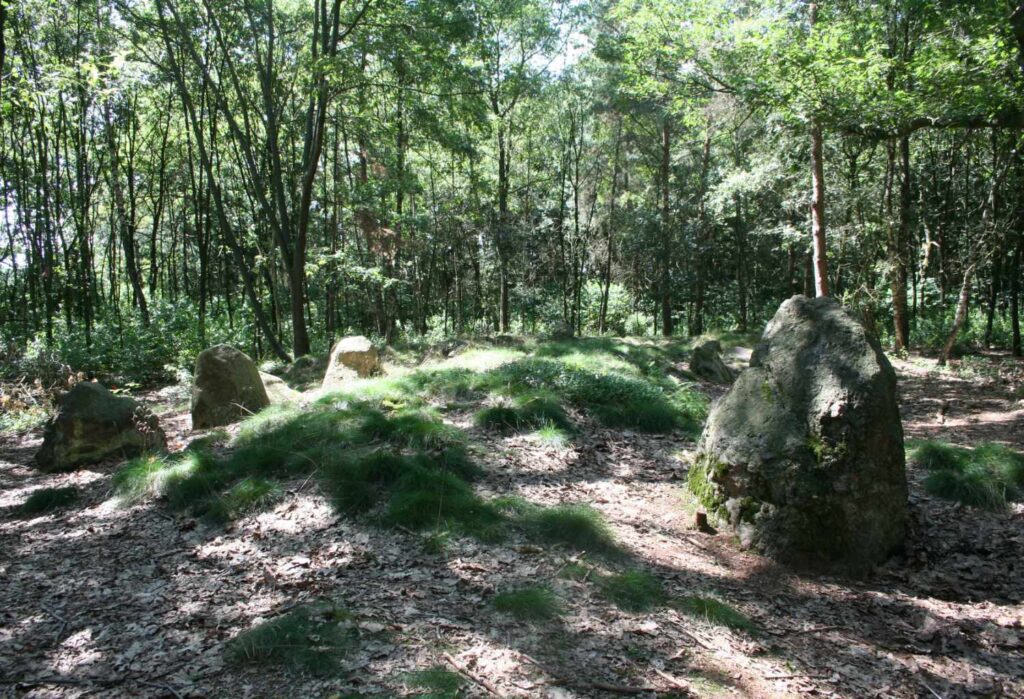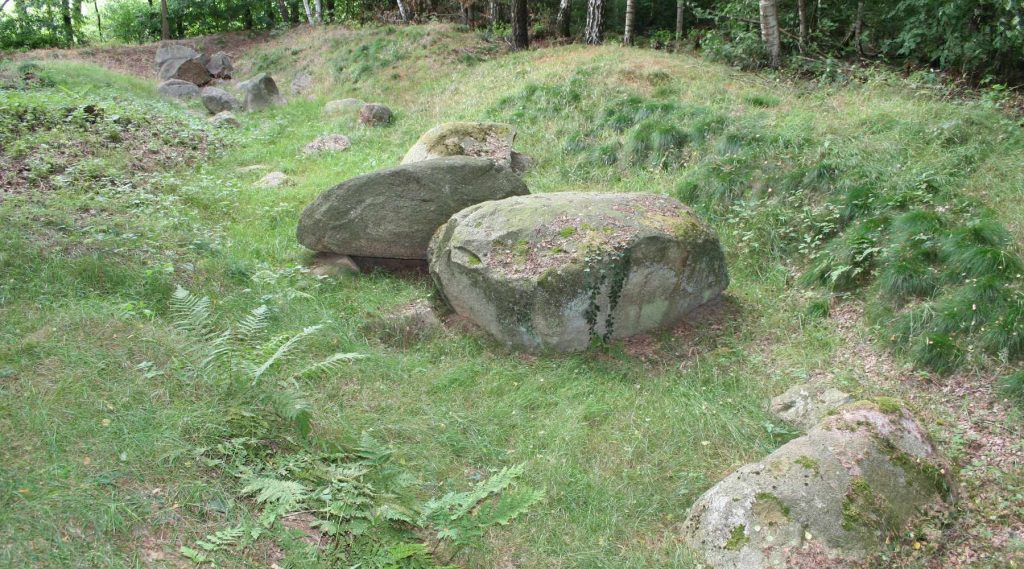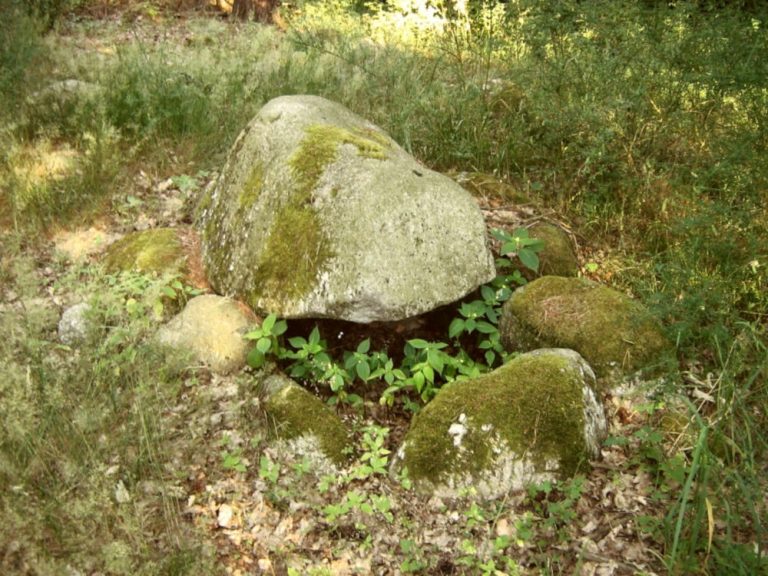
The Barkvieren dolmen, also known as the Barkvieren 3 Megalithic Tomb, is located about 1.3 km northwest of two largely destroyed sites in the Gnewitz district in Mecklenburg-Western Pomerania, Germany. The east-west oriented megalithic complex is a large stone grave of the Funnel Beaker Culture and was created between 3500 and 2800 BCE. It has no Sprockhoff number because it was only discovered in 1959.
Discovery and dating of the Barkvieren dolmen
Dating back to between 3500 and 2800 BCE, this east-west oriented megalithic structure is a tomb belonging to the Funnel Beaker Culture. The Barkvieren dolmen was only discovered in 1959. The approximately 26 m long structure was excavated and reconstructed by Ewald Schuldt in 1965. There were no grave goods remaining in the Barkvieren dolmen at that point.
Layout of the site
The site consists of a parallel dolmen with five supporting and two capstones (one of which is preserved), featuring a top entrance (a very early form). It is situated at the eastern end of a slightly trapezoidal (approximately 4.6 m wide at its widest and 3.1 m at its narrowest) Hünenbett, or giant’s bed, of which only parts remain intact (27 stones in the southeast are preserved, while 59 are missing). Two guardian stones were placed at the wide side, one of which is now broken. Aside from four pottery sherds, no other artifacts were found, likely due to previous looting of the site.